

Table of Contents
- Why Recording Daily Sales Actually Matters
- What Most Nigerian Traders Do Instead (And Why It Costs Them)
- How to Record Daily Sales: A Simple Step-by-Step Method
- What Exactly Should You Record Every Day?
- Tools You Can Use to Record Daily Sales
- Common Mistakes to Avoid
- How Navolet Makes Daily Sales Recording Effortless
- Frequently Asked Questions
- Conclusion
You close your shop at 8PM. Your hands are tired, your feet are sore, and you know you sold a lot today. But here is the real question — do you actually know how much profit you made? Not how much cash you received. Not what your customers paid. Actual profit, after expenses.
For most Nigerian small business owners, the honest answer is no. And that silence is costing them more than they realise.
Learning how to record daily sales is one of the simplest and most powerful habits you can build as a business owner. It takes less than five minutes a day, and the difference it makes to your profit clarity is enormous.
In this guide, you will learn exactly how to do it — even if you have never kept proper records before, and even if you currently run your business from memory or a WhatsApp group.
Why Recording Daily Sales Actually Matters
Many traders believe they have a feel for how their business is doing. They know roughly what they sell. They remember the big days and the slow ones. But feelings are not numbers, and numbers are the only language profit speaks.
Here is what happens when you do not record your sales daily:
- You cannot tell if your business is growing or shrinking month on month.
- You have no evidence when it is time to apply for a loan or attract investors.
- You do not know which products are making you money and which are wasting your stock space.
- You cannot correctly calculate your tax obligations to FIRS without accurate sales records.
- You cannot spot when a staff member or customer is stealing from you.
On the other hand, business owners who record their daily sales consistently report one major benefit above everything else: they stop being surprised. They know where they stand every single day.

What Most Nigerian Traders Do Instead (And Why It Costs Them)
Walk into any market in Lagos, Aba, Kano, or Port Harcourt and you will find the same story. Smart, hardworking business people managing everything from memory. A few write things down in a notebook — but with no structure, no consistency, and no way to make sense of the numbers later.
Others use WhatsApp voice notes to remind themselves of what they sold. Some keep receipts in a rubber band and count them at the end of the month. A few use spreadsheets they barely understand.
None of these methods give you what you actually need: a clear, daily picture of your sales, expenses, and profit.
According to the Small and Medium Enterprises Development Agency of Nigeria (SMEDAN), poor record keeping is one of the top reasons Nigerian SMEs struggle to scale or access financing. You are not alone in this — but you can change it today.
How to Record Daily Sales: A Simple Step-by-Step Method
You do not need accounting software or a university degree to start recording your sales properly. Here is a method that works even if you are starting from scratch.
Step 1: Write Down Every Sale as It Happens
The biggest mistake traders make is trying to remember everything at the end of the day. Memory is unreliable, especially after a busy day. Get into the habit of recording each sale at the point it happens — or within minutes of it.
Write down: the item sold, the quantity, and the amount received. That is it.
Step 2: Separate Cash Sales from Credit Sales
Not every sale means money in your hand. If a customer bought goods but has not paid yet, that is a credit sale. It is still a sale — but you have not received the cash. Recording these separately helps you track who owes you money and prevents you from spending money you do not yet have.
Step 3: Record Your Expenses for the Day
Sales alone do not tell the full story. A day where you sold ₦80,000 but spent ₦70,000 on restocking, transport, and generator fuel is not a good day. Record every expense — no matter how small — so you can calculate your real profit.
Step 4: Calculate Your Daily Profit
At the end of each day, subtract your total expenses from your total sales. That number is your daily profit. If it is positive, you made money. If it is negative or very small, you need to investigate why.
Step 5: Review Weekly and Monthly
Daily records become even more powerful when you review them over time. A weekly review shows you your busiest days. A monthly review shows you your growth — or reveals problems you need to fix.
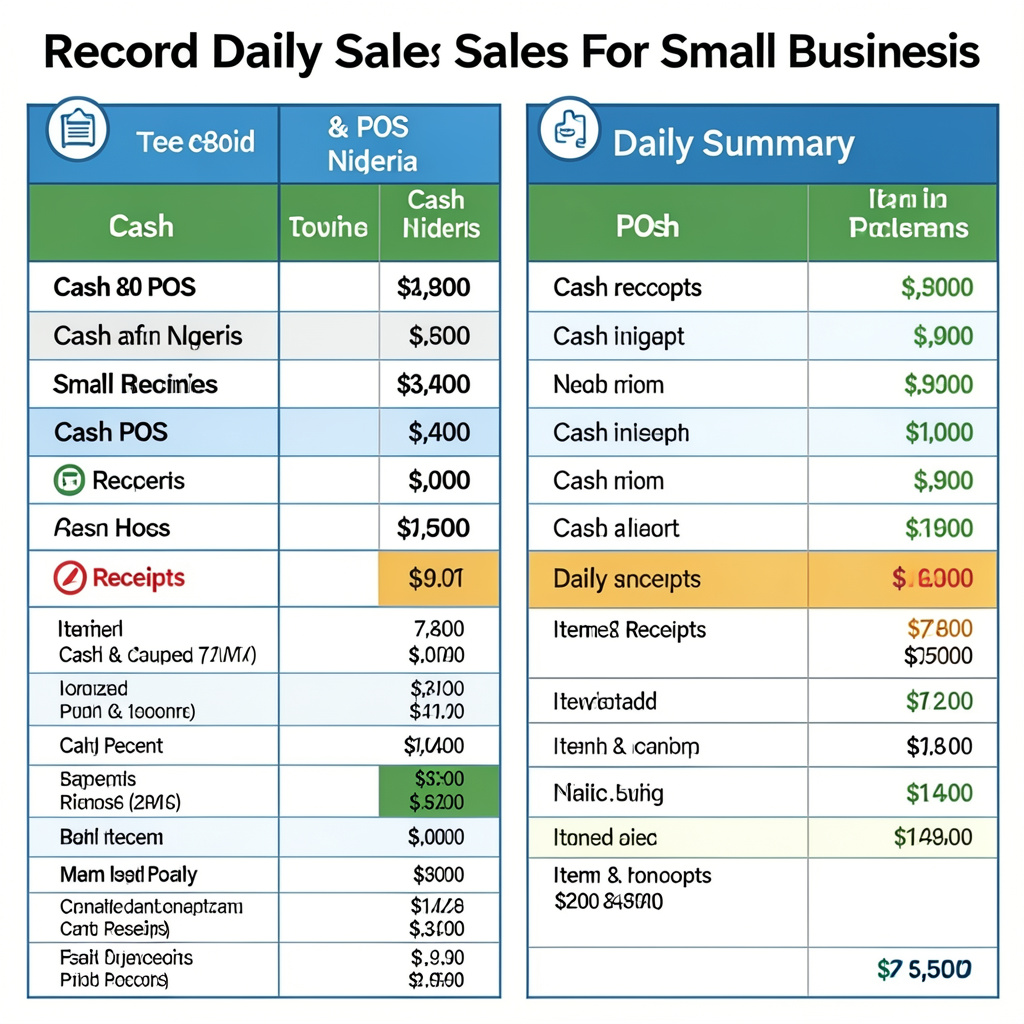
What Exactly Should You Record Every Day?
A complete daily sales record should contain the following information:
- Date — every record must have a date.
- Customer name — especially for credit sales or repeat customers.
- Product or service sold — be specific. “Fabric” is not enough. “5 yards Ankara at ₦3,500 per yard” is better.
- Quantity sold — this also helps you track stock depletion.
- Selling price — what the customer paid.
- Cost price — what you paid to acquire or produce the item.
- Payment method — cash, transfer, or credit.
- Amount received — especially if there was a partial payment.
When you have all of this information, you can calculate profit per item, track customer debts, monitor your best-selling products, and understand your true daily income.
Tools You Can Use to Record Daily Sales
Let us look honestly at the options available to a Nigerian business owner, from the most basic to the most powerful.
A Physical Notebook
This is where most people start. It costs nothing, requires no power, and needs no internet. The downside is that it cannot calculate profit automatically, it cannot send you reminders, it cannot generate a report, and it is easily lost or damaged.
A notebook is better than nothing — but it has real limits.
Microsoft Excel or Google Sheets
A spreadsheet gives you more power than a notebook. You can create formulas to calculate profit, sort data, and build simple summaries. However, it requires you to know how to use it, it takes time to set up properly, and it needs a laptop or phone with the right apps installed.
For many market traders and shop owners, a spreadsheet is more complicated than it needs to be.
A Business Management Tool Like Navolet
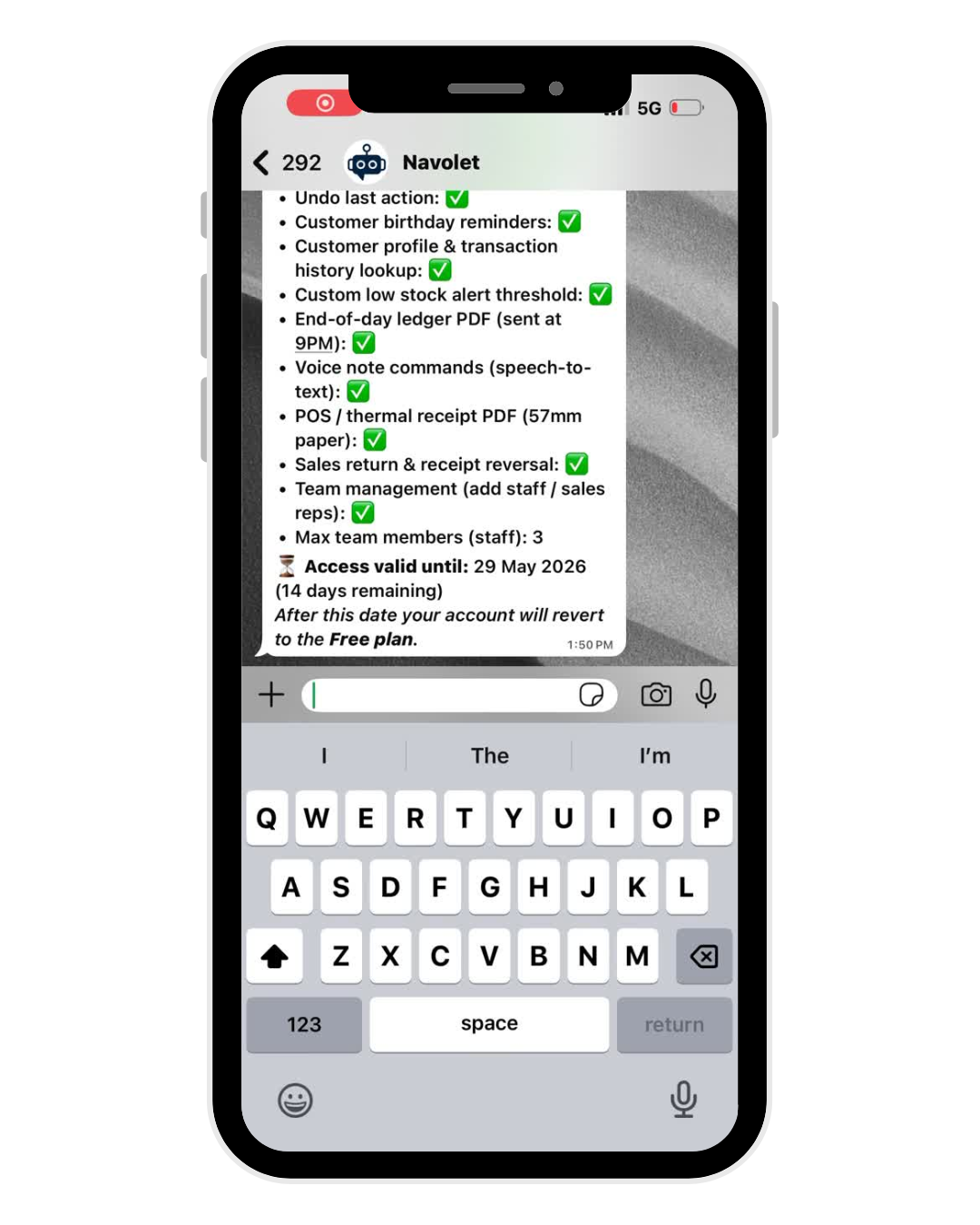
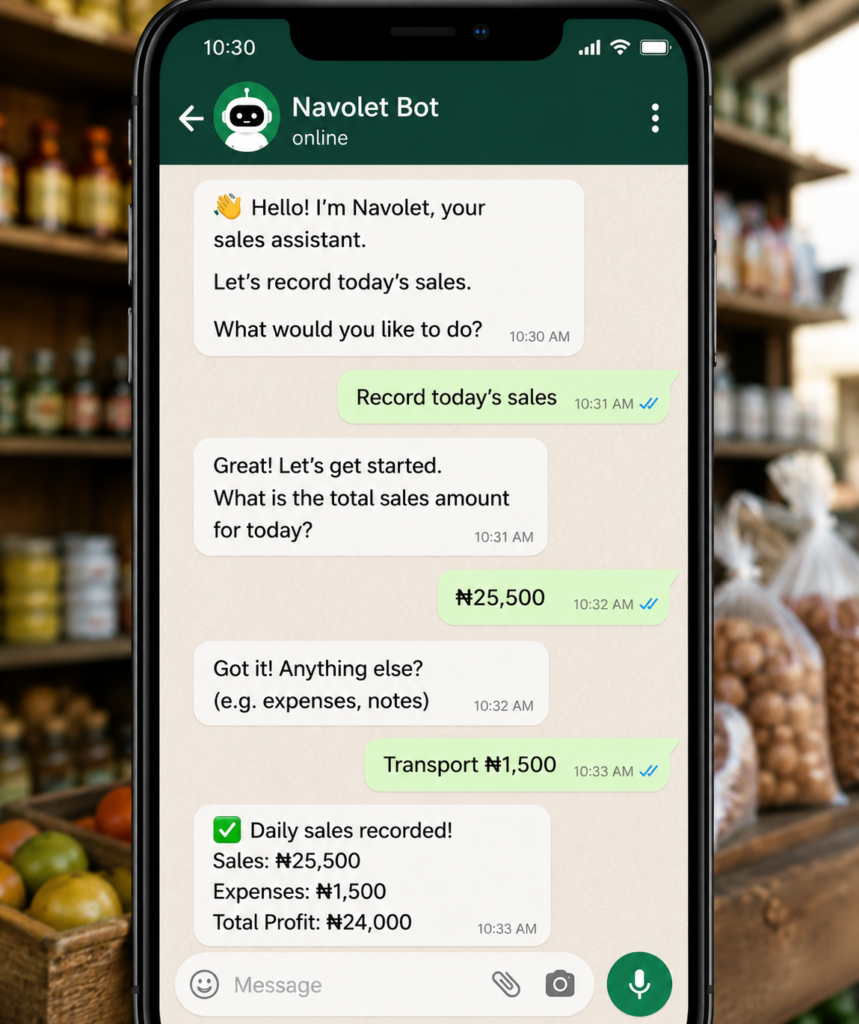
This is where things get genuinely easy. A purpose-built tool designed for Nigerian business owners can record your sales, calculate your profit, track your inventory, and send you a daily summary — all through a simple chat interface on WhatsApp or Telegram.
No spreadsheets. No complicated software. Just chat with the bot the way you chat with a friend.
Common Mistakes to Avoid When You Record Daily Sales
Even business owners who try to keep records often make these mistakes. Avoid them and your records will be far more useful.
Mixing Business Money with Personal Money
This is one of the most common and most damaging habits among small business owners. When you use the same account or wallet for business and personal spending, your records become impossible to trust. Your business profit and your personal income blur together, and you can never get an accurate picture of either.
Keep your business finances separate. Always.
Recording Sales but Not Expenses
A record that shows only sales gives you a false sense of profit. The real number — the one that matters — is what is left after every cost has been accounted for. Transport, electricity, packaging, staff costs, market fees, and restocking are all expenses that must be recorded.
Waiting Until the End of the Week
Memory fades fast. If you wait until Friday to record Monday’s sales, you will miss details, confuse transactions, and end up with inaccurate numbers. Record daily — even if it is just a quick note at closing time.
Not Tracking Credit Sales
Every naira your customers owe you is part of your income that has not arrived yet. If you do not record it, you will forget it. And forgotten debts are lost money.

How Navolet Makes Daily Sales Recording Effortless
Everything described in this guide — recording each sale, tracking expenses, calculating daily profit, managing credit sales, monitoring stock — can be done automatically with Navolet, an AI-powered business management tool built specifically for Nigerian vendors and small business owners.
Here is what makes Navolet different from a notebook or a spreadsheet:
- No app to download. Navolet works entirely through WhatsApp and Telegram, platforms you already use every day.
- Record a sale in seconds. Just send a message like “Sold 3 bags of rice at ₦25,000 each” and Navolet records the sale, deducts from your stock, and updates your daily report.
- Automatic daily profit report at 9PM. Every evening, Navolet sends you a summary of your sales, expenses, and net profit for the day — so you always close your day knowing exactly where you stand.
- Track customer debts automatically. Tell Navolet that a customer bought on credit and it keeps the record, tracks partial payments, and tells you who owes you money at any time.
- Professional PDF invoices and receipts. Create and send branded invoices instantly — no design skills needed.
- Works in Nigerian English and Pidgin. You can even send voice notes. Navolet understands how Nigerians actually talk.
The result is a complete, accurate picture of your business — every day, without extra effort.
Navolet is available on a free plan to get started, with affordable paid plans for growing businesses. You can also explore the FAQs page to see how it works before you begin.
Frequently Asked Questions
How do I record daily sales without a computer?
You can use a physical notebook with a consistent format — date, item, quantity, price, and payment method. However, the easiest option for Nigerian business owners is to use a WhatsApp-based tool like Navolet, which lets you record sales by simply sending a message from your phone.
What is the difference between revenue and profit?
Revenue is the total amount your customers paid you. Profit is what is left after you subtract all your expenses. A business with high revenue but high expenses may actually be making very little profit. Recording both sales and expenses every day gives you the true profit figure.
How do I track credit sales from customers?
When a customer buys on credit, record the transaction immediately — including the customer’s name, the amount owed, and the date. Review your credit records weekly and follow up with customers before debts grow too large. Tools like Navolet track this automatically and show you a list of everyone who owes you money at any time.
How many times a day should I record my sales?
Ideally, record each sale as it happens. If your business is very busy, record in small batches throughout the day rather than waiting until closing. The more often you record, the more accurate your data will be.
Can recording sales help me get a business loan?
Yes. Many Nigerian lenders and microfinance institutions require at least 3–6 months of sales records before approving a loan. Consistent, organised records demonstrate that your business is genuine and financially stable. According to the Central Bank of Nigeria, SME financing is directly tied to the quality of financial documentation provided by business owners.
Is it difficult to start recording sales if I have never done it before?
Not at all. Start simple. Pick one method — a notebook, a spreadsheet, or a tool like Navolet — and begin today. You do not need to record historical data. Just start from today, and within one month you will already have more clarity about your business than most traders ever get.
Conclusion
Recording your daily sales is not a complicated accounting exercise. It is a simple habit that takes a few minutes a day and gives you something priceless in return: the truth about your business.
When you know your daily sales figures, you can make better decisions. You know when to restock, when to cut costs, which products to push, and which customers to follow up with. You stop guessing and start knowing.
Start today. Even a basic notebook is better than nothing. And if you want to make the whole process automatic — without spreadsheets, without complicated software, and without any app downloads — give Navolet a try.
It was built for exactly this: to help hardworking Nigerian business owners stop losing money to poor records, and start understanding their business clearly, every single day.
Start Recording Your Sales the Smart Way — Free
Join thousands of Nigerian business owners who use Navolet to track sales, calculate profit, and manage their business — all through WhatsApp and Telegram. No app download. No complicated setup. Just message the bot and you are ready in two minutes.