
In this article:
- Why Recording Sales and Expenses Actually Matters
- What Exactly Should You Record?
- How to Record Your Sales the Right Way
- How to Record Your Business Expenses
- Why You Must Separate Business Money from Personal Money
- Make It a Daily Habit — Not a Monthly Panic
- The Tools You Can Use to Record Sales and Expenses
- Frequently Asked Questions
- Conclusion
You closed your shop at 7PM. You sold a lot today — you could feel it. But do you actually know how much profit you made? Not revenue. Not the cash in your hand. Actual profit, after all your costs?
Most Nigerian small business owners cannot answer this question — and that silence is costing them more than they realise. Learning how to record sales and expenses is one of the most important skills any trader, vendor, or retailer can develop. It does not require an accountant. It does not require a spreadsheet. It just requires a system.
This guide will show you exactly what to record, how to record it, and how to use that information to grow a business that actually makes money.
Why Recording Sales and Expenses Actually Matters
Many small business owners in Nigeria operate on vibes. If there is money in the drawer at the end of the day, the business is “doing well.” If the drawer is empty, things were slow.
The problem is, that approach does not tell you anything useful. You could be making revenue every day and still be running at a loss because your costs are too high. Or you could be sitting on customers who owe you money and not even know it.
According to the U.S. Small Business Administration, poor financial management is one of the leading reasons small businesses fail. The same principle applies in Nigeria — businesses that do not track their numbers cannot make good decisions.
When you record your sales and expenses properly, you gain the ability to:
- Know your actual profit — not a guess
- Spot which products make you the most money
- See how much customers owe you
- Prepare for tax season without stress
- Make smarter decisions about restocking, pricing, and spending

What Exactly Should You Record?
Before we get into how to record, you need to know what to record. There are two sides to every business transaction: money coming in and money going out.
Money Coming In (Income)
- Sales: Every item you sell and the amount received
- Partial payments: When a customer pays part of what they owe
- Credit sales: When a customer takes goods and promises to pay later
Money Going Out (Expenses)
- Business expenses: Shop rent, generator fuel, delivery costs, staff wages, packaging, restocking
- Personal expenses: School fees, groceries, family bills — these must be recorded separately (more on this below)
You also want to keep records of your stock — what you have, what you sold, and what is running low. Without stock records, you will keep running out of products and losing sales you did not even know you missed.
How to Record Your Sales the Right Way
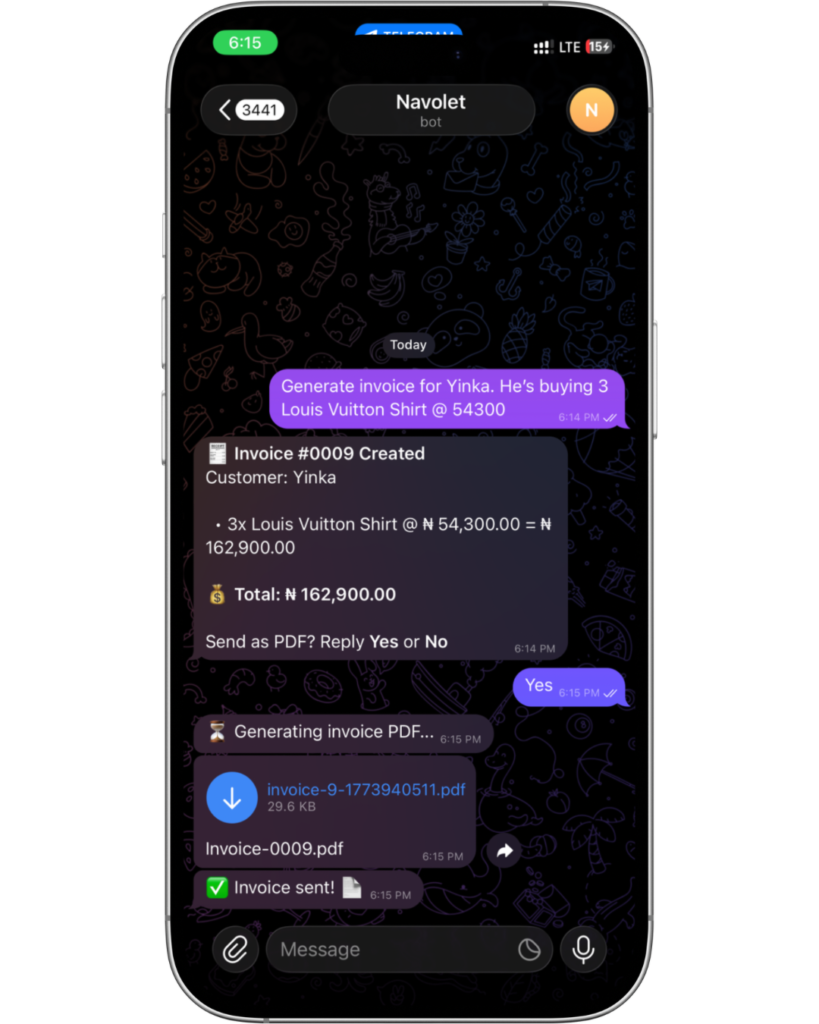
Recording a sale means capturing three things: what was sold, how much it sold for, and whether it was paid or on credit.
For each sale, you should note:
- The date of the sale
- The product or service sold
- The quantity
- The selling price
- The customer’s name (especially for credit sales)
- Whether payment was received in full, in part, or not yet
If you are still using a notebook, that is fine as a starting point. However, notebooks get lost, torn, and rained on. A notebook also cannot add up your totals for you or tell you which customer owes you money.
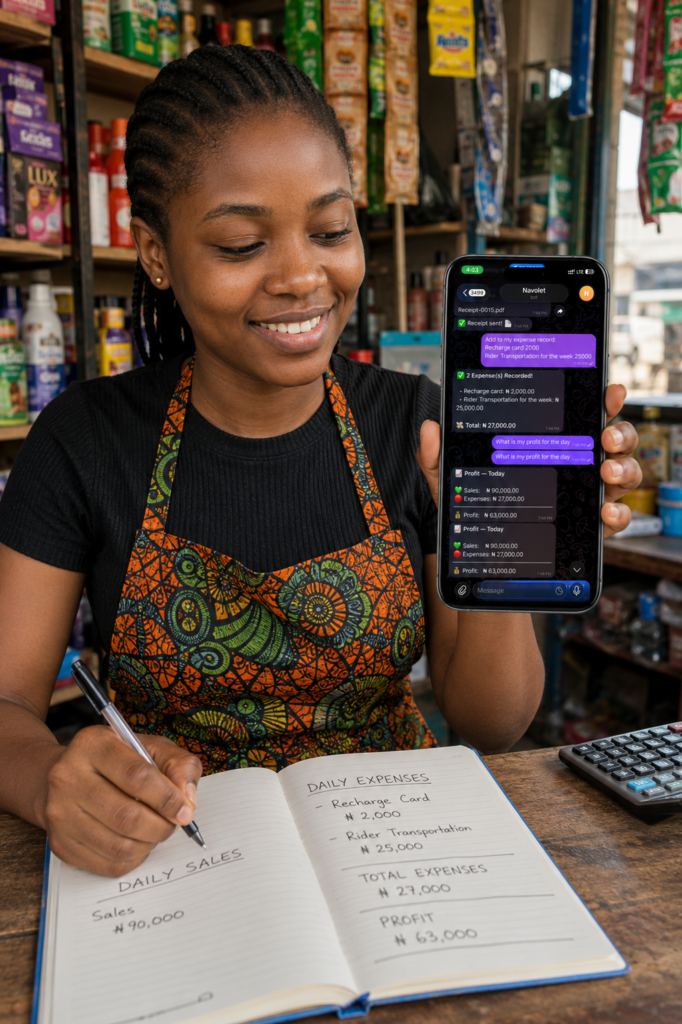
A better approach is to use a tool that records your sales automatically, deducts from your stock, and keeps a running total of your profit. Navolet lets you record a sale by simply sending a WhatsApp message — something like: “Sold 5 bags of rice at 25,000 each” — and it handles the rest.
What About Credit Sales?
Credit sales are where most small businesses leak money silently. You give someone goods today and they promise to pay next week. Next week becomes next month. Next month becomes “I don’t remember that.”
Every credit sale must be recorded with the customer’s name, the amount owed, the date, and what was taken. This is called debt or credit tracking, and it is one of the most important records you can keep. Learn more about how to protect yourself in our guide on how to track money customers owe you.
How to Record Your Business Expenses
Many business owners only record sales and ignore expenses. This is a serious mistake. Your profit is not what you earn — it is what you earn minus what you spend.
For every business expense, record:
- The date
- What the expense was for (e.g., “generator fuel,” “shop rent”)
- The amount paid
- Whether it is a business or personal expense
Business expenses reduce your taxable income, which matters when tax season comes around. In Nigeria, the Federal Inland Revenue Service (FIRS) expects businesses to maintain proper financial records. Without documented expenses, you may end up paying more tax than necessary.
Common Business Expenses Nigerian SMEs Forget to Record
- Data and airtime used for business
- Transportation to the market to restock
- Small repairs on equipment or shop fittings
- Printing costs for receipts or packaging materials
- Bank transfer fees and POS charges
These small amounts add up. When you do not record them, your “profit” looks higher than it really is — and you end up spending money you do not actually have.
Why You Must Separate Business Money from Personal Money
This is one of the most common financial mistakes Nigerian small business owners make. When personal spending and business spending are mixed together, it becomes impossible to know whether your business is actually profitable.
Imagine you run a provision store. On Monday, you use shop money to buy food for the house. On Tuesday, you dip into the same money to restock. By the end of the week, you cannot tell what was spent on the business and what was spent on the family.
The solution is simple: treat your business like a separate entity. Give yourself a fixed “salary” from the business each month. Everything else stays in the business account and is used only for business purposes.
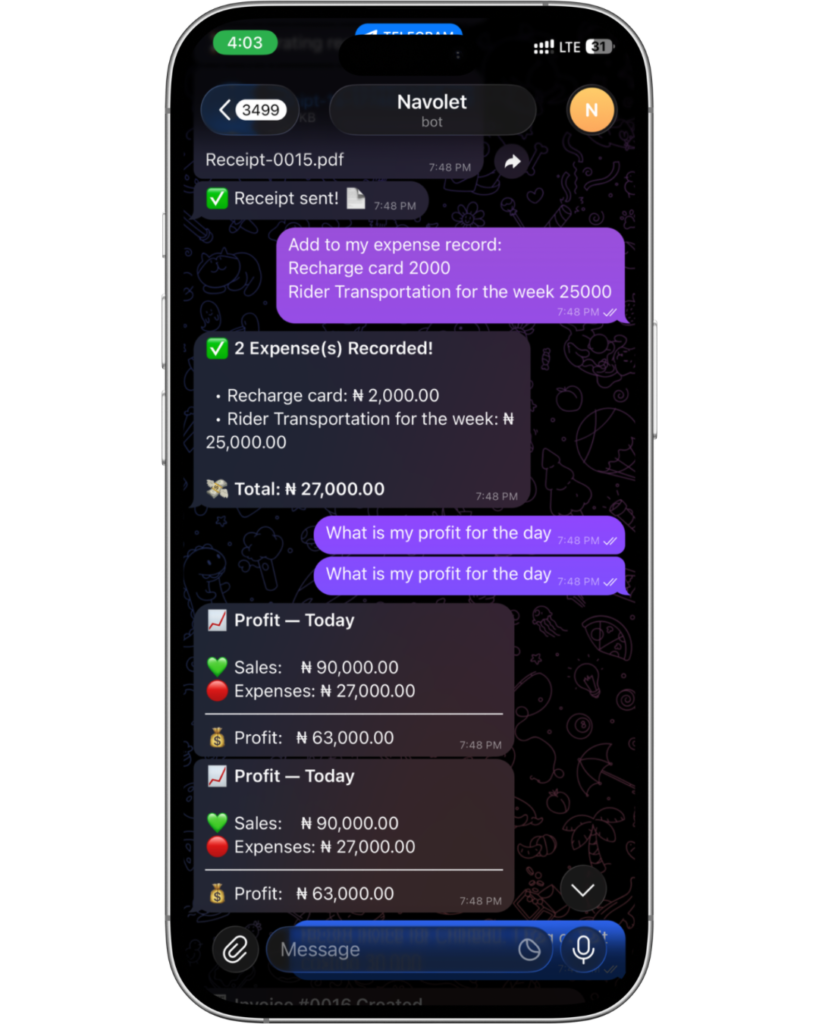
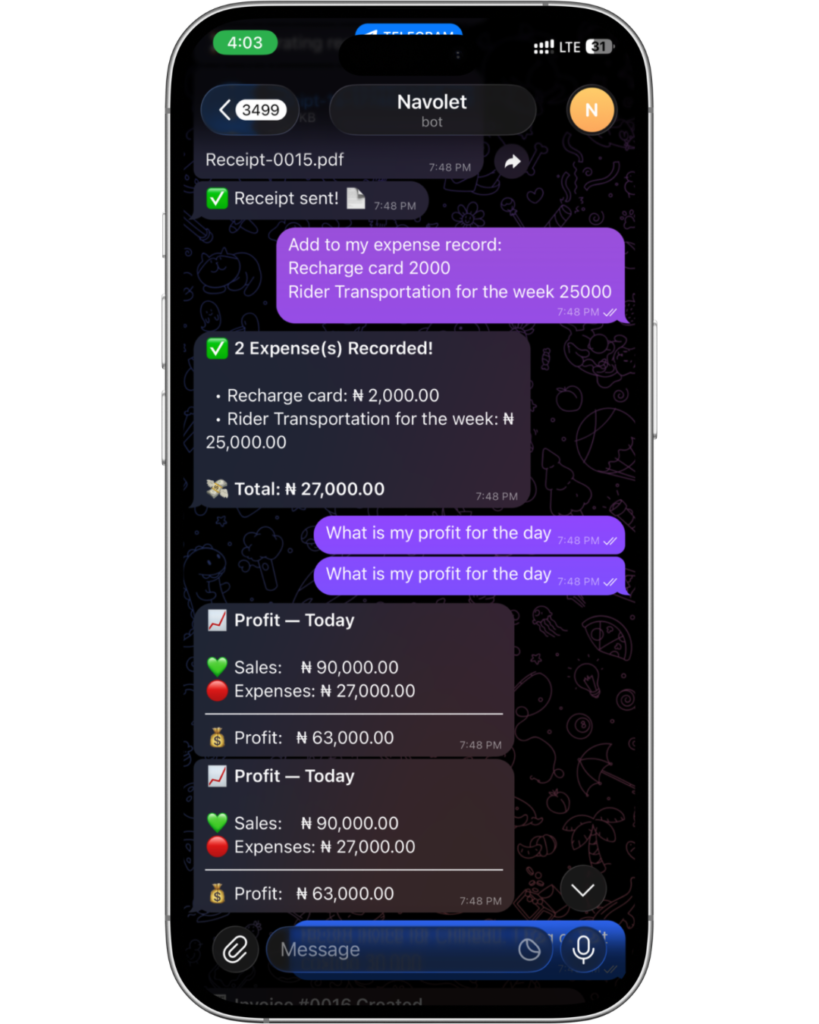
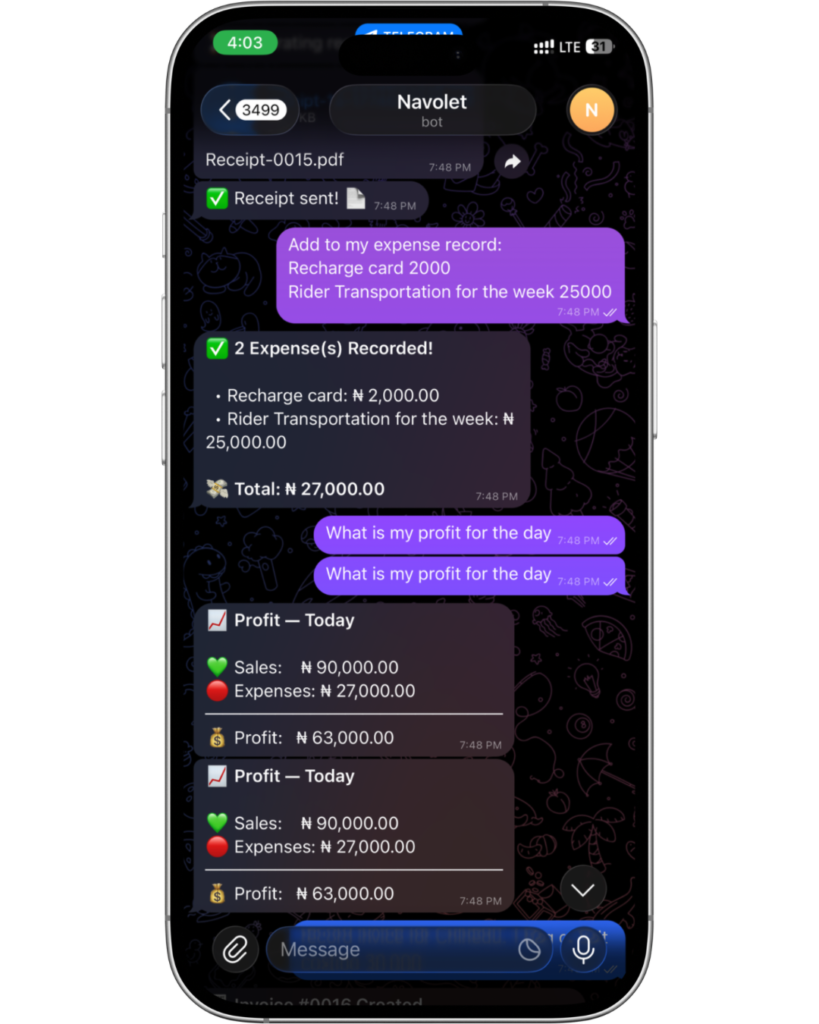
When you record expenses in a tool like Navolet, it automatically separates business expenses from personal ones — so your tax calculations and profit reports stay clean and accurate.
Make It a Daily Habit — Not a Monthly Panic
Choose a voice
The biggest reason most small business owners do not keep proper records is not lack of knowledge — it is timing. They plan to “record everything at the end of the week” and then the week disappears. By the time they sit down to do the numbers, half the receipts are gone and the memory has faded.
The solution is to record as you go — in real time.
Every time you make a sale, record it immediately. Every time you spend money on the business, note it down right away. This habit takes less than 30 seconds per transaction. However, skipping it for even two or three days creates a backlog that most people never recover from.
The 9PM Rule
One practical approach is to set a reminder for 9PM every evening. Before you sleep, take five minutes to review what came in and what went out during the day. If you use Navolet, this is done for you automatically — the app sends you a daily report at 9PM showing your total income, expenses, and net profit for the day.
That kind of visibility changes everything. You stop guessing and start knowing.
The Tools You Can Use to Record Sales and Expenses
You have several options when it comes to tools. Here is an honest look at each one:
1. Paper Notebook
Pros: Free, always available, no battery needed.
Cons: Cannot calculate profit automatically, gets lost or damaged, cannot remind you of unpaid debts, impossible to search or export.
2. Spreadsheets (Excel or Google Sheets)
Pros: More organised than a notebook, can do basic calculations.
Cons: Requires discipline to update consistently, formula errors are common, not mobile-friendly for on-the-go recording.
3. WhatsApp-Based Business Tools
Pros: No new app to learn, works where you already spend time, instant recording by sending a message.
Cons: Requires internet access.
This is where Navolet stands out. It is a business management tool that works entirely through WhatsApp and Telegram — no app download required. You simply send a message to the bot and it records your sale, updates your stock, tracks expenses, and generates your daily profit report automatically.
According to research from GSMA’s Mobile Money Report, over 180 million Nigerians use mobile phones, and WhatsApp remains the most-used app among small business operators. A tool that lives inside WhatsApp removes the biggest barrier to consistent record keeping: the habit barrier.
You can explore all of Navolet’s features — including sales tracking, expense recording, invoice generation, and the tax calculator — on the Navolet pricing page.
Frequently Asked Questions
How often should I record my sales and expenses?
Ideally, you should record every transaction as it happens. If that is not possible, do it at the end of each business day. Waiting until the end of the week almost always leads to missing records and inaccurate numbers.
Do I need an accountant to track sales and expenses?
No. Basic daily records do not require an accountant. What you need is a consistent system. An accountant becomes useful when you are filing taxes or growing the business significantly — and having clean records makes their job (and your bill) much cheaper.
What is the difference between revenue and profit?
Revenue is the total money you receive from sales. Profit is what is left after you subtract all your expenses. A business with high revenue can still run at a loss if expenses are higher than income. This is why tracking both matters.
What should I do if a customer owes me money?
Record the debt immediately when the credit sale happens — including the customer’s name, the amount, the date, and what was taken. Follow up at the agreed time. Tools like Navolet can show you a list of all outstanding debts so nothing falls through the cracks.
Is Navolet free to use?
Navolet has a free plan on Telegram that lets you try core features with no payment required. Paid plans (Standard and Pro) unlock more features including expense tracking, profit reports, voice note commands, and unlimited transactions. See the full breakdown on the pricing page.
Can I use Navolet for tax purposes?
Yes. Navolet has a built-in Nigerian tax engine that calculates your Personal Income Tax and VAT based on your actual business data. You can also export a tax report as an Excel file to share with your accountant or submit to the relevant tax authority.
Conclusion
Knowing how to record sales and expenses is not complicated — but it does require consistency. Every sale recorded. Every expense noted. Every credit tracked. Those small daily actions give you something that most Nigerian small business owners do not have: a clear, honest picture of what their business is actually doing.
When you have that picture, everything else gets easier. You make better decisions. You stop spending money you do not have. You know which customers to chase for payment. And when tax season arrives, you are not panicking — you are prepared.
The good news is that you do not need to be a financial expert to get this right. You just need a system that works — one that fits into the way you already run your business, not one that adds more work to your day.
Start Tracking Sales and Expenses the Smart Way — Free
Navolet is a WhatsApp-based business tool built specifically for Nigerian small business owners like you. There is no app to download. You simply message the bot and it records your sales, tracks your expenses, manages your stock, and sends you a daily profit report at 9PM every evening.
Setting up takes less than two minutes.
Start your free Navolet trial today — just message the bot on WhatsApp to get started.