

Table of Contents
- The Problem Most Nigerian Business Owners Don’t Want to Admit
- Why Recording Your Sales Is Not Optional
- What Counts as a Sale? (More Than You Think)
- How to Record Sales for a Small Business: Step-by-Step
- 5 Common Mistakes Nigerian Business Owners Make When Recording Sales
- What Tool Should You Use to Record Sales?
- How Navolet Makes Sales Recording Effortless
- Frequently Asked Questions
- Conclusion
If you run a small business in Nigeria, here is a question that should make you stop and think: Do you actually know how much profit you made today? Not what entered your hand. Not what a customer promised to pay. Your actual profit — after every expense, every debt, every product that left your shop.
Most traders cannot answer that question honestly. And if you cannot answer it, then learning how to record sales for a small business is the single most important thing you can do for your business right now.
This post will show you exactly how to do it — step by step — in a way that is simple enough to use every single day, whether you run a fashion boutique in Lagos, a provision store in Port Harcourt, or a food business in Abuja.

The Problem Most Nigerian Business Owners Don’t Want to Admit
You wake up, open your shop, sell all day, and by evening your hand is tired and your voice is hoarse. Business was good. But when you try to calculate your profit, you get confused.
Where did the money go? How much did you spend on restock? What did that customer on credit owe again? Which items sold well today?
This is the daily reality for millions of Nigerian business owners. According to the Small and Medium Enterprises Development Agency of Nigeria (SMEDAN), poor record keeping is one of the top reasons small businesses fail within the first five years.
However, the problem is not laziness. The problem is that nobody ever taught business owners how to record sales properly — in a way that is fast, easy, and actually useful.
That ends today.
Why Recording Your Sales Is Not Optional
Some business owners think recording sales is only for “big companies.” That is a dangerous mistake.
Here is what happens when you do not track your sales properly:
- You cannot tell if your business is growing or shrinking.
- You restock products that are not selling and run out of products that are.
- Customers buy on credit and you forget who owes you — and how much.
- You mix personal money with business money until you cannot tell the difference.
- At the end of the month, you feel like you worked hard but have nothing to show for it.
In addition, proper sales records protect you during tax season. The Federal Inland Revenue Service (FIRS) requires business owners to keep financial records for a minimum of six years. Without them, you are exposed.
Therefore, recording your sales is not just about knowing your profit. It is about protecting everything you have worked to build.
What Counts as a Sale? (More Than You Think)
Before you can record sales correctly, you need to understand what counts as a sale in the first place.
A sale is any transaction where a customer gives you money — or promises to give you money — in exchange for your product or service. This includes:
- Cash sales: A customer walks in, pays immediately, and leaves with the product.
- Credit sales: A customer takes the product today but pays later. This is still a sale — even if the money has not arrived yet.
- Partial payments: A customer pays half now and promises to pay the rest next week.
- Online/transfer payments: Bank transfers or mobile money payments for goods or services.
Many business owners only record cash that physically entered their hand. As a result, they undercount their actual sales and miscalculate their profit. Do not make that mistake.
How to Record Sales for a Small Business: Step-by-Step
Here is a simple, practical method you can start using today — even if you have never tracked sales before.
Step 1: Record Every Sale Immediately
Do not wait until the end of the day. Every time a sale happens, record it right away. Write down the item sold, the quantity, the price, and whether the customer paid in full or on credit.
The longer you wait, the more you forget. And the more you forget, the more money you lose track of.
Step 2: Record the Customer’s Name for Credit Sales
If a customer buys on credit, always record their name and phone number alongside the sale. Many business owners lose thousands of naira every month simply because they cannot remember who owes them money.
You can learn more about tracking customer debts in our post on how to track money customers owe you.
Step 3: Separate Sales from Expenses
Your sales record should only capture money coming in. Keep a separate record for expenses — what you spent on restock, delivery, rent, and other costs.
This separation is what allows you to calculate your real profit. Revenue minus expenses equals profit. Without both records, the calculation is impossible.
Step 4: Record Your Cost Price Alongside Your Selling Price
For each product, note how much it cost you to buy or produce it, and how much you sold it for. This is how you calculate your profit margin per item.
For example, if you bought a bag of rice for ₦25,000 and sold it for ₦30,000, your gross profit on that item is ₦5,000. Multiply that across all your products and you will know exactly how your business is performing.
Step 5: Review Your Sales at the End of Every Day
Spend five minutes every evening reviewing the day’s sales. Ask yourself: What sold most? What did not sell? Did all customers pay? Are there any unpaid invoices from today?
This daily habit is the foundation of a healthy business. It is also the only way to know your profit before the end of the month — instead of being surprised by the numbers.
5 Common Mistakes Nigerian Business Owners Make When Recording Sales
Even business owners who try to keep records often make mistakes that undermine the whole effort. Here are the most common ones — and how to avoid them.
Mistake 1: Only Recording What You Remember
If you rely on memory, you will always undercount your sales. A busy day in the market means dozens of transactions. You cannot remember them all. Record every sale as it happens — not later.
Mistake 2: Mixing Business Money with Personal Money
This is one of the most dangerous habits for any business owner. When business and personal funds are mixed, it becomes impossible to know your true profit. Keep them completely separate — even if your business is small.
We cover this in detail in our article on why mixing business and personal money is dangerous.
Mistake 3: Ignoring Credit Sales
A sale on credit is still a sale. Not recording it means you are working for free — and you will not even know it until it is too late.
Mistake 4: Not Tracking Stock Alongside Sales
Every sale should reduce your stock. If you record sales without updating inventory, you will run out of products without warning. Poor stock management is one of the biggest causes of lost revenue for Nigerian SMEs.
See how inventory tracking connects to your sales in our guide on why your business keeps running out of stock.
Mistake 5: Waiting Until Month-End to Review Records
Monthly reviews give you information too late to act on it. By the time you realise something went wrong, a full month of losses has already happened. Daily reviews — even quick ones — catch problems early.
What Tool Should You Use to Record Sales?
There are several ways to record sales. Here is an honest look at each option.
Paper and Notebook
Simple and free. However, notebooks get lost, torn, or soaked in rain. They are also very hard to search through when you need to find a specific transaction. In addition, a notebook cannot calculate your profit automatically.
Spreadsheets (Excel or Google Sheets)
More organised than a notebook, and free with a Google account. However, spreadsheets require you to set up formulas yourself, and most small business owners find them confusing. A mistake in one formula can corrupt your entire record.
The U.S. Small Business Administration recommends digital record-keeping tools over spreadsheets for accuracy and consistency — advice that applies equally to Nigerian SMEs.
WhatsApp-Based Business Tools
This is where the future is for Nigerian small businesses. Tools that work through WhatsApp or Telegram require no app download, no complex setup, and no learning curve. You just type naturally — and the tool handles the records for you.
How Navolet Makes Sales Recording Effortless
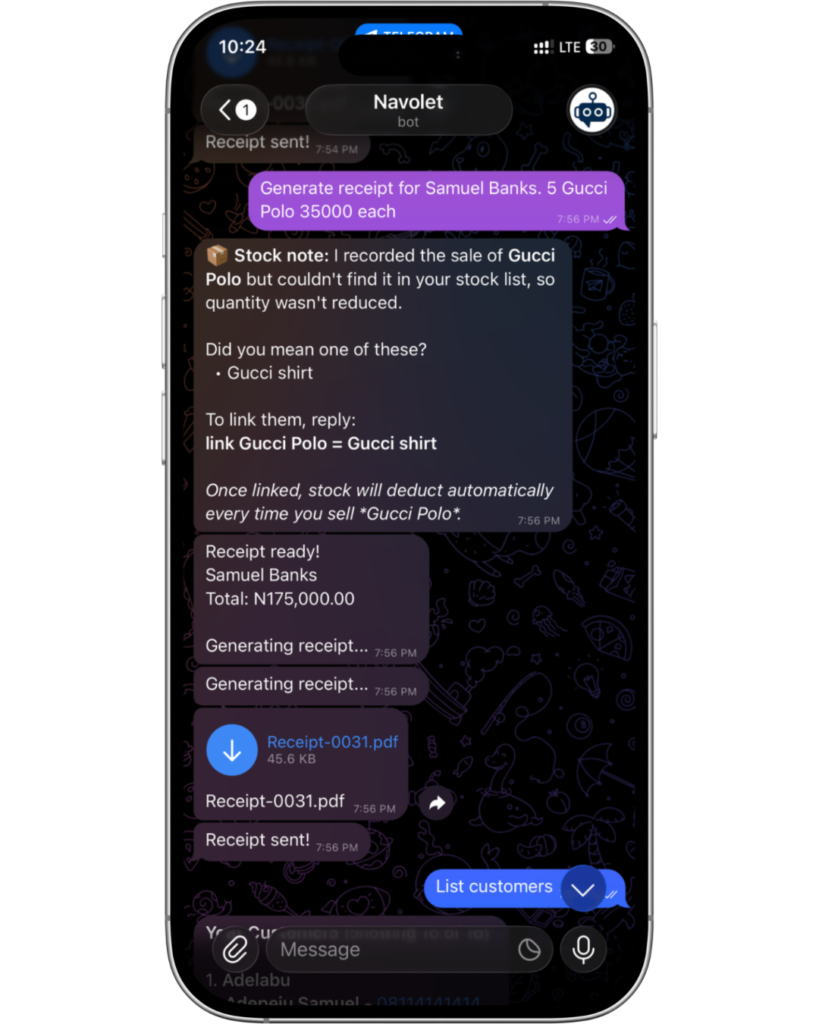
Navolet is an AI-powered business management tool that runs entirely through WhatsApp and Telegram. There is no app to download. You simply send a message to the Navolet bot — in plain English or Nigerian Pidgin — and it records your sales instantly.
Here is how it works in practice:
- You type: “Sold 5 bags of rice at ₦30,000 each” — and Navolet records the sale, deducts the stock, and updates your daily profit.
- You type: “Blessing bought 3 shirts on credit” — and Navolet logs the credit sale, saves Blessing’s balance, and reminds you when it is unpaid.
- You type: “What is my profit today?” — and Navolet tells you instantly, including all expenses and credits.
Every evening at 9PM, Navolet automatically sends you a full summary of the day — total sales, total expenses, net profit, top-selling product, and any unpaid invoices. No chasing. No calculations. Just clarity.
Navolet also handles credit and debt tracking, stock management, professional PDF invoices, and even a built-in Nigerian tax calculator. Everything a small business owner needs — all in one place, inside the app you already use every day.
Visit Navolet’s pricing page to see the plans available, starting from a completely free tier.
Frequently Asked Questions
How do I record sales for a small business without a computer?
You can use a notebook, but a much better option is a WhatsApp-based tool like Navolet. You simply type your sales in plain language on your phone, and the tool records everything automatically — no computer needed.
What information should I include when recording a sale?
At minimum, record the date, the item sold, the quantity, the selling price, the cost price, and whether the customer paid in full or on credit. If it was a credit sale, also record the customer’s name and phone number.
How often should I record my sales?
Record every sale as it happens. Do not wait until end of day or end of week. Real-time recording is the only way to get accurate, reliable numbers.
Is it okay to use WhatsApp to keep business records?
On its own, WhatsApp is not a record-keeping tool. However, tools like Navolet use WhatsApp as the interface while storing your records securely in a proper business database. You get the ease of chatting with the power of professional bookkeeping.
Do I need to record credit sales even if the customer has not paid yet?
Yes — absolutely. A credit sale is still income you are owed. Recording it protects you from forgetting who owes you money, and it gives you an accurate picture of how your business is truly performing.
What is the difference between sales records and an invoice?
A sales record is your internal log of every transaction. An invoice is a formal document you send to a customer showing what they owe you. Both are important. Navolet handles both automatically — it records the sale and generates a professional PDF invoice at the same time.
Conclusion
Knowing how to record sales for a small business is not complicated — but it does require discipline and the right system. Every sale you fail to record is money you cannot track, profit you cannot calculate, and growth you cannot plan for.
The good news is that you do not need accounting software, a bookkeeper, or an expensive computer to do this well. You need a simple habit, a clear method, and a tool that does the heavy lifting for you.
Start today. Record every sale. Track every debt. Review every day. Because the business owners who know their numbers are the ones who survive — and grow.
Start Recording Your Sales the Smart Way — With Navolet
Stop guessing your profit. Stop losing track of customer debts. Stop running out of stock without warning.
Navolet makes it effortless to record every sale, track every naira, and know your profit every single day — all from WhatsApp, in plain English or Pidgin. No app download. No spreadsheets. No confusion.
Start your free Navolet trial today. Just message the bot on WhatsApp and you are set up in under 2 minutes.