

Table of Contents
- Why Sales Record Keeping Is Silently Killing Your Business
- What Is Sales Record Keeping — and Why Most Traders Get It Wrong
- The Real Cost of Poor Record Keeping in Nigeria
- 5 Signs Your Sales Records Are Costing You Money Right Now
- A Simple Sales Record Keeping System Any Trader Can Use
- Common Mistakes Nigerian Business Owners Make With Their Records
- Tools and Apps for Sales Record Keeping in Nigeria
- Frequently Asked Questions
- Conclusion
Why Sales Record Keeping Is Silently Killing Your Business
You close your shop at 8PM. You sold a lot today — the shop was busy, money entered your hand, customers came and went. But when you sit down tonight, can you actually answer this question: how much profit did you make today?
Not revenue. Not what you collected. Actual profit — after every expense, every restocked item, every delivery cost you paid. Most Nigerian small business owners cannot answer this question. And that silence is costing them more than they realise.
This is the real problem with sales record keeping in Nigeria. It is not that traders do not care about their numbers. It is that nobody ever taught them a system simple enough to actually use — while also running a business, managing customers, and handling life at the same time.
In this guide, you will learn exactly why record keeping matters, what it is actually costing you, and the practical steps you can take starting today — even if you have never kept proper books in your life.

What Is Sales Record Keeping — and Why Most Traders Get It Wrong
Sales record keeping is the practice of tracking every transaction in your business — every sale, every expense, every debt a customer owes you, and every item you receive into stock.
It sounds simple. But most small business owners in Lagos, Abuja, and Port Harcourt are doing one of three things instead:
- Keeping everything in their head
- Writing scattered notes in a jotter that gets lost
- Sending voice notes to themselves on WhatsApp and forgetting about them
These approaches feel like record keeping. They are not. They are just memory with extra steps — and memory is not reliable enough to run a profitable business on.
According to the Small and Medium Enterprises Development Agency of Nigeria (SMEDAN), poor financial record keeping is one of the top reasons Nigerian small businesses fail within the first three years. This is not a small problem. It is a survival problem.
The good news is that fixing it does not require an accountant or expensive software. It requires a system — and the commitment to use it consistently.
The Real Cost of Poor Record Keeping in Nigeria
Here is what nobody tells you: the money you are losing from poor records is invisible. You cannot see it leaving. There is no moment where you feel it go. But it goes.
Consider a fashion seller in Yaba who sells ₦500,000 worth of goods every month. She thinks she is profitable because money is always coming in. But without proper records, she has no idea that:
- Three customers owe her a combined ₦85,000 that she has stopped chasing
- She has been selling two of her fabric types below cost price for four months
- Her generator fuel, packaging, and transport costs have quietly risen by ₦40,000 per month
- She restocked an item she already had in surplus because she had no inventory record
Add those up. That is over ₦100,000 in silent losses every single month — from a business that looks healthy from the outside. This is the danger of operating without reliable sales record keeping.
The National Bureau of Statistics reports that SMEs contribute over 48% of Nigeria’s GDP — but many of these businesses are operating with extremely thin profit margins that poor record keeping erodes even further.
When you do not know your numbers, you cannot grow. You cannot plan. You cannot confidently restock, hire staff, take a loan, or even know whether this month was better or worse than last month. You are essentially running your business blind.
5 Signs Your Sales Records Are Costing You Money Right Now
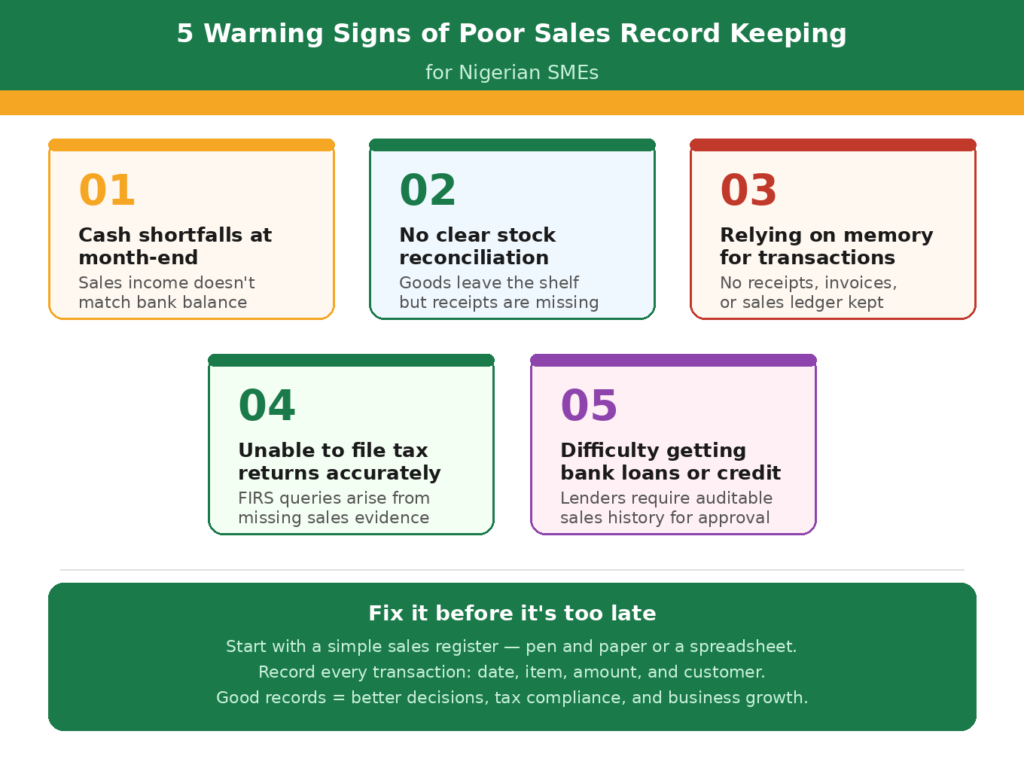
Not sure if this is your problem? Here are five signs that your approach to sales record keeping is quietly hurting you:
1. You Cannot Tell Your Daily Profit Without Calculating for an Hour
If knowing your profit for today requires digging through receipts, WhatsApp messages, and memory, your system is broken. You should be able to check your profit in under two minutes.
2. You Are Always Surprised When Stock Runs Out
You buy something, sell it gradually, and only discover it is finished when a customer asks for it. This means you have no real-time visibility into your inventory — which leads to lost sales and embarrassed moments at the counter.
3. Customers Owe You Money and You Cannot Track Who or How Much
You know someone owes you, but you are not 100% sure of the amount. You feel awkward chasing them because you are not certain of the number. Meanwhile, that debt quietly expires. This is one of the most common and painful consequences of poor sales record keeping.
4. You Cannot Prepare for Tax Season
When it is time to deal with tax obligations, you have nothing organised. No expense records, no income records, no separation between your business account and personal spending. This creates stress — and potentially unnecessary tax payments. You can learn more about your obligations from the Federal Inland Revenue Service (FIRS).
5. You Do Not Know Which Products Are Actually Profitable
You have a feeling that some products sell well, but you genuinely do not know which ones are making you money after costs. As a result, you keep restocking products that are eating your margin while ignoring the ones that could make you rich.
A Simple Sales Record Keeping System Any Trader Can Use
Here is the reality: a great record keeping system does not have to be complicated. It just has to be consistent. Below is a practical framework that works even if you are not an accountant.
Step 1: Record Every Sale — Every Single One
No sale is too small to record. Whether it is ₦500 or ₦50,000, every transaction must be captured. Include the date, item sold, quantity, and amount received. If the payment was partial, note the balance owed.
Step 2: Track Every Expense Separately from Your Personal Spending
This is where most traders fall apart. Business money and personal money mix together, and suddenly you have no idea what you actually spent on the business. Create a clear separation. Every business expense — from market transport to packaging to generator fuel — must be recorded separately.
The danger of mixing personal and business finances is so serious that we wrote a full post about it: The Danger of Mixing Your Business Money With Personal Money.
Step 3: Update Your Stock After Every Sale
When you sell an item, deduct it from your inventory record immediately. Do not wait until end of day. Real-time stock tracking is what prevents you from running out of goods without warning.
Step 4: Record All Customer Debts
If a customer buys on credit, write it down immediately. Include their name, the amount, and the expected payment date. Review this list at least once a week. A simple list of people who owe you money, updated regularly, can recover thousands of naira you would otherwise forget about.
Step 5: Review Your Numbers Every Evening
At the end of each business day, spend five to ten minutes reviewing your totals. Total sales. Total expenses. Net profit. Outstanding debts. This habit — done consistently — will transform your understanding of your business within 30 days.

Common Mistakes Nigerian Business Owners Make With Their Records
Even business owners who try to keep records often make avoidable mistakes. Here are the most common ones:
Mistake 1: Waiting Until Month-End to Record
Some traders try to reconstruct their entire month from memory at the end of each month. By that point, most of the details are gone. Record keeping only works if it is done in real time — or at least daily.
Mistake 2: Not Recording Small Expenses
That ₦500 you spent on printing. The ₦1,500 you paid for emergency packaging. The airtime you bought to call your supplier. These small costs add up to significant amounts by month-end. Every naira of expense that goes unrecorded is profit that disappears invisibly.
Mistake 3: Confusing Revenue With Profit
Revenue is what came into your hand. Profit is what is left after every expense. Many traders look at their revenue and feel successful — without realising their expenses have swallowed their profit entirely. Good sales record keeping forces you to see both numbers clearly.
Mistake 4: Not Tracking the Cost Price of Items Sold
If you do not know what you paid for an item, you cannot know whether you are selling it profitably. This is especially dangerous when prices from your supplier increase — it is easy to keep selling at the old price without realising you are now selling at a loss.
Tools and Apps for Sales Record Keeping in Nigeria
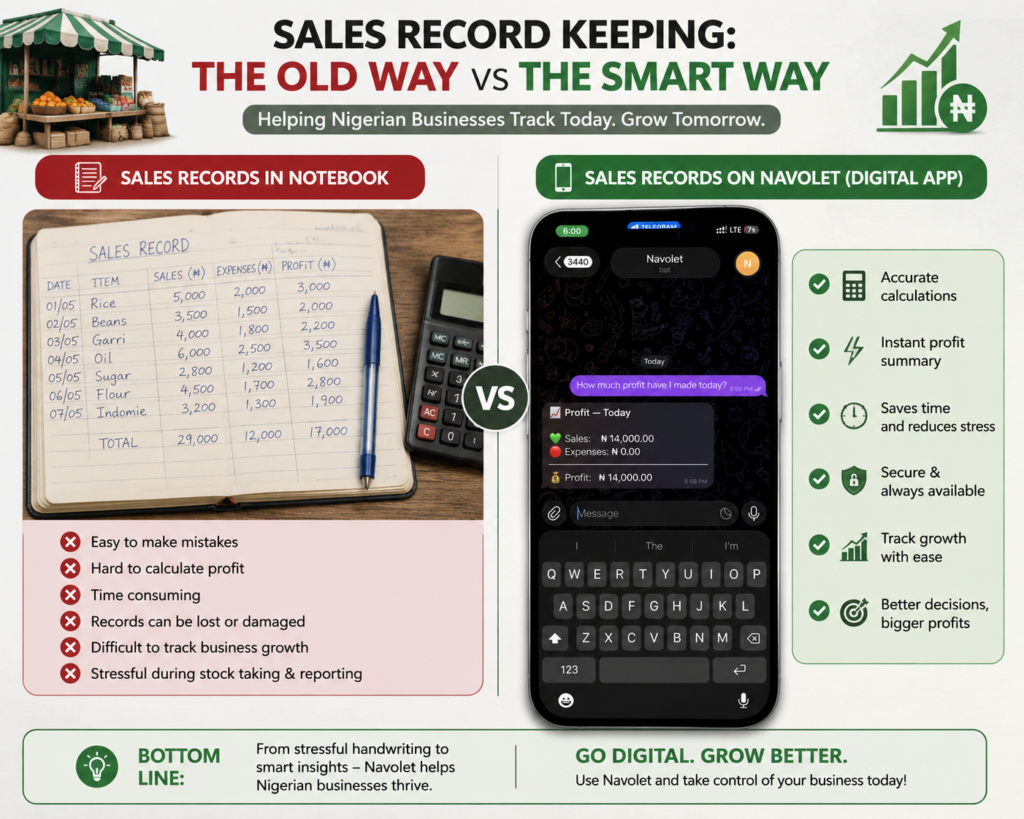
Let us be practical. Most traders will not maintain a manual ledger consistently. It requires too much time and discipline. This is why digital tools exist — and why the right tool can completely transform how you run your business.
Notebooks and Jotters
The most basic option. Better than nothing, but prone to being lost, damaged, or simply not updated. It also makes it impossible to quickly calculate totals, track trends, or generate reports.
Spreadsheets
Tools like Microsoft Excel or Google Sheets are more reliable than paper, but they require time to set up, consistent updating, and some level of formula knowledge. Many traders start with spreadsheets and abandon them within weeks because the process feels too slow.
WhatsApp-Based Business Management Tools
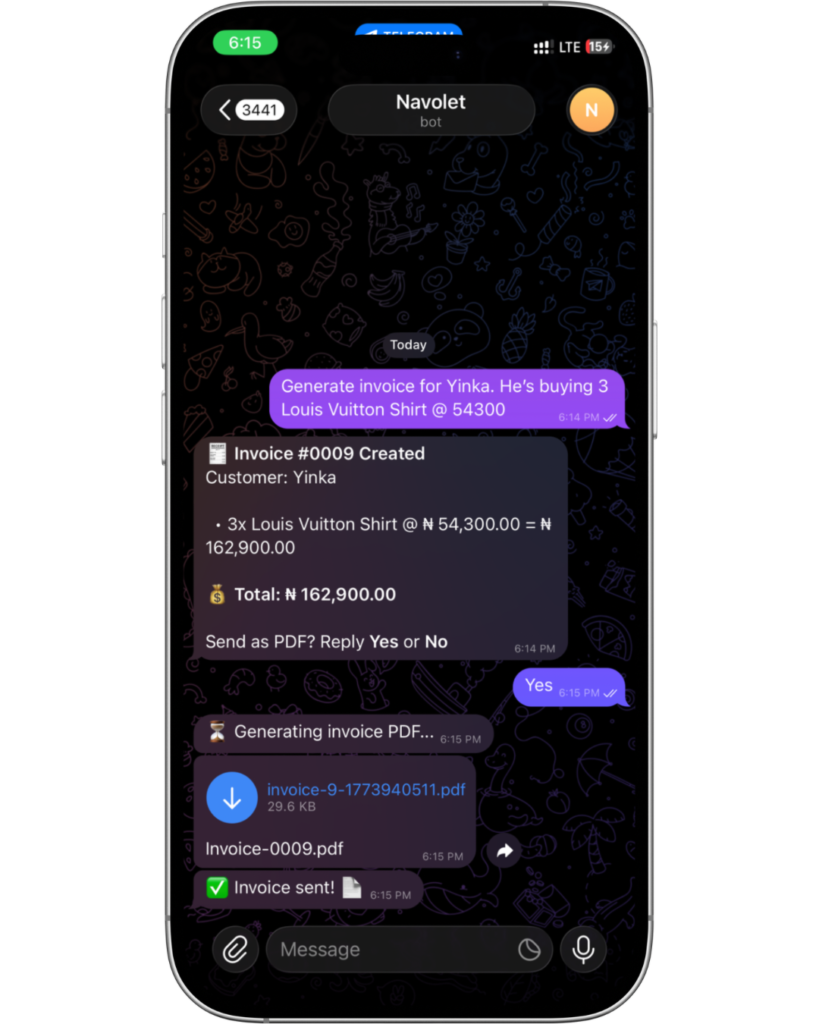
This is where tools like Navolet come in. Navolet is an AI-powered business management assistant that works entirely through WhatsApp and Telegram. You simply chat with the Navolet bot in plain English or Nigerian Pidgin — no app to download, no complicated software to learn.
With Navolet, your sales record keeping happens automatically as part of your normal business flow. You record a sale by chatting with the bot. Stock is deducted automatically. Customer debts are tracked in real time. And every evening at 9PM, Navolet sends you a complete summary of your day — your total sales, expenses, profit, and any outstanding invoices.
You can also learn how Navolet helps you track money customers owe you without a notebook, and how it makes it easy to know your daily profit in under two minutes.
Plans start from ₦0 on the Free plan, with the Standard plan at ₦5,000/month and the Pro plan at ₦10,000/month. You can compare all features on the Navolet pricing page.
According to a 2023 report by the International Finance Corporation (IFC), SMEs that adopt digital financial tools are significantly more likely to survive and grow than those relying on manual systems. The evidence is clear: the tool you use for record keeping directly affects how your business performs.
Frequently Asked Questions About Sales Record Keeping in Nigeria
What is the simplest way to start sales record keeping for my small business?
Start by recording every sale and every expense in a dedicated notebook or app — daily, not weekly. The most important habit is consistency. Even a basic daily record of “what I sold today” and “what I spent today” is far better than nothing. Over time, move to a digital tool that automates this for you.
Do I need an accountant to keep proper business records?
No. For most Nigerian small businesses, a simple system that tracks sales, expenses, stock, and customer debts is enough to run a healthy operation. Accountants become more necessary when you are preparing formal financial statements or tax filings — but day-to-day record keeping can absolutely be done by the business owner using the right tools.
How do I track what customers owe me?
Every time a customer buys on credit, record their name, the amount, and the date immediately. Review the list weekly and follow up with customers who have outstanding balances. Tools like Navolet do this automatically — the bot tracks every credit transaction and can show you who owes you money at any time. You can also read our detailed guide on how to track customer debts for small businesses.
How often should I update my business records?
Ideally, in real time — meaning every transaction is recorded as it happens. If that is not possible, at a minimum you should update your records every evening before you close. Waiting longer than 24 hours makes it very easy to forget important details.
Is it important to separate business and personal expenses?
Absolutely. Mixing personal and business money is one of the most common mistakes traders make — and one of the most damaging. Without separation, you cannot know your true profit, you cannot prepare accurate tax records, and you cannot make informed decisions about your business. This deserves its own guide, which you can read here: Why Mixing Business and Personal Money Is Dangerous.
Can I use my phone to manage business records in Nigeria?
Yes — and this is increasingly the best approach for Nigerian SMEs. Tools like Navolet work directly through WhatsApp, which means you already have everything you need on your phone. No additional apps, no complicated setup. You just chat with the bot to record sales, track stock, and manage debts.
Conclusion: Your Records Are the Foundation of Your Business
Here is the truth that most business advisors never say plainly: a trader who knows their numbers will always outperform a trader who does not — even if the second trader works twice as hard.
Sales record keeping is not a luxury for big businesses. It is the foundation that every profitable small business is built on. When you know your daily profit, your stock levels, your outstanding debts, and your real expenses, you stop guessing and start making decisions. You stop working hard on the wrong things and start growing.
The good news is that starting is easier than you think. You do not need a degree in accounting. You do not need expensive software. You just need a system you will actually use — and the discipline to use it every day.
Whether you start with a notebook today or move directly to a digital tool, what matters is that you start. Because every day you operate without clear records is another day your business is bleeding money you could have kept.
Ready to Take Control of Your Business Records?
Navolet makes sales record keeping effortless for Nigerian small business owners. There is no app to download. No complicated setup. You simply chat with the bot on WhatsApp or Telegram and it handles your records automatically — tracking sales, expenses, stock, customer debts, and daily profit in real time.
Every evening at 9PM, you receive a full summary of your day. Every morning at 8AM, you get a motivational report with yesterday’s numbers. And at any time, you can ask the bot: “What is my profit today?” — and get an instant, accurate answer.
Start your free Navolet plan today — no payment required, no app to download. Just message the bot on WhatsApp and you are set up in two minutes.
→ Start Your Free Navolet Account Here
Already curious about what else Navolet can do? Explore the full features and pricing, or read more about how it helps Nigerian businesses track profit daily without a spreadsheet.